One of the most common patterns in struggling software projects is premature execution. Development begins while requirements are still changing. Design continues while engineers are already implementing features. Launch planning starts before the system has been tested under realistic conditions. These situations rarely happen because teams are careless — they happen because the delivery process lacks a mechanism to determine whether the project is actually ready to move forward. Without that mechanism, progress is driven by timelines, optimism, or pressure from stakeholders.
Stage-gated delivery addresses this with a simple principle: a project should only move forward when the knowledge required for the next stage exists.
What a Stage Gate Is
A stage gate is a checkpoint between phases of a project. Before the project moves to the next phase, the delivery team verifies that specific conditions have been satisfied — conditions that involve artifacts, decisions, or documentation demonstrating the project has reached a stable understanding of the system. A stage gate is not a meeting or a status update. It is a verification step that answers a specific question: Is the project ready to proceed? If yes, the project advances. If no, the team resolves the missing information before continuing.
Why Projects Move Too Early
In many organizations, software delivery follows an implicit sequence. A project is sold, discovery happens quickly, design begins, development starts soon after, and testing occurs near the end of the timeline. This sequence appears structured, but in practice the transitions between phases are informal. Teams move forward because the calendar says they should, not because earlier work is complete. Scope may still be ambiguous, user journeys may be partially defined, the architecture may still be evolving — but the project continues anyway. Each unresolved question eventually surfaces during later stages, where the cost of correction is much higher.
How Stage-Gated Delivery Works
Stage-gated delivery replaces informal transitions with explicit readiness checks. Each phase of delivery produces artifacts and decisions that reduce uncertainty about the system, and a project advances only after the required conditions for that phase are satisfied.
| Stage | Gate Question |
|---|---|
| Intake | Do we understand the project well enough to begin strategy? |
| Strategy | Do we know what the system must do? |
| Design | Do we know how the system should behave for users? |
| Specification | Is the work defined clearly enough for development? |
| Build | Has the system been implemented according to the specification? |
| Release | Is the system ready for production deployment? |
Each stage introduces clarity that the next stage depends on. Design cannot be stable until system capabilities are known. Development cannot proceed efficiently until design decisions have been translated into executable specifications. Stage gates enforce this sequence.
The Limits of Rigid Gates
While the principle is sound, hard binary gates fail to reflect how modern software delivery actually works.
Real projects are not linear. Teams often need to begin technical validation while strategy is still being refined, or start designing one feature while another is still in discovery. A gate that blocks all design work until every strategy condition is 100% satisfied creates bottlenecks that slow teams capable of managing parallel work streams.
Binary gates also create a false sense of security. A "green light" implies that everything in that stage is resolved — but a project might meet the minimum criteria to pass a gate while still carrying significant unresolved issues. The go/no-go signal hides the nuance that delivery teams actually need to make good decisions.
From Gates to Readiness Signals
The more useful model replaces binary gates with continuous readiness signals — a live, computed view of how safe it is to proceed with any given activity, given the project's current state of knowledge.
Instead of asking "Is this stage complete?", the system asks:
"Given what we currently know, how safe is it to proceed?"
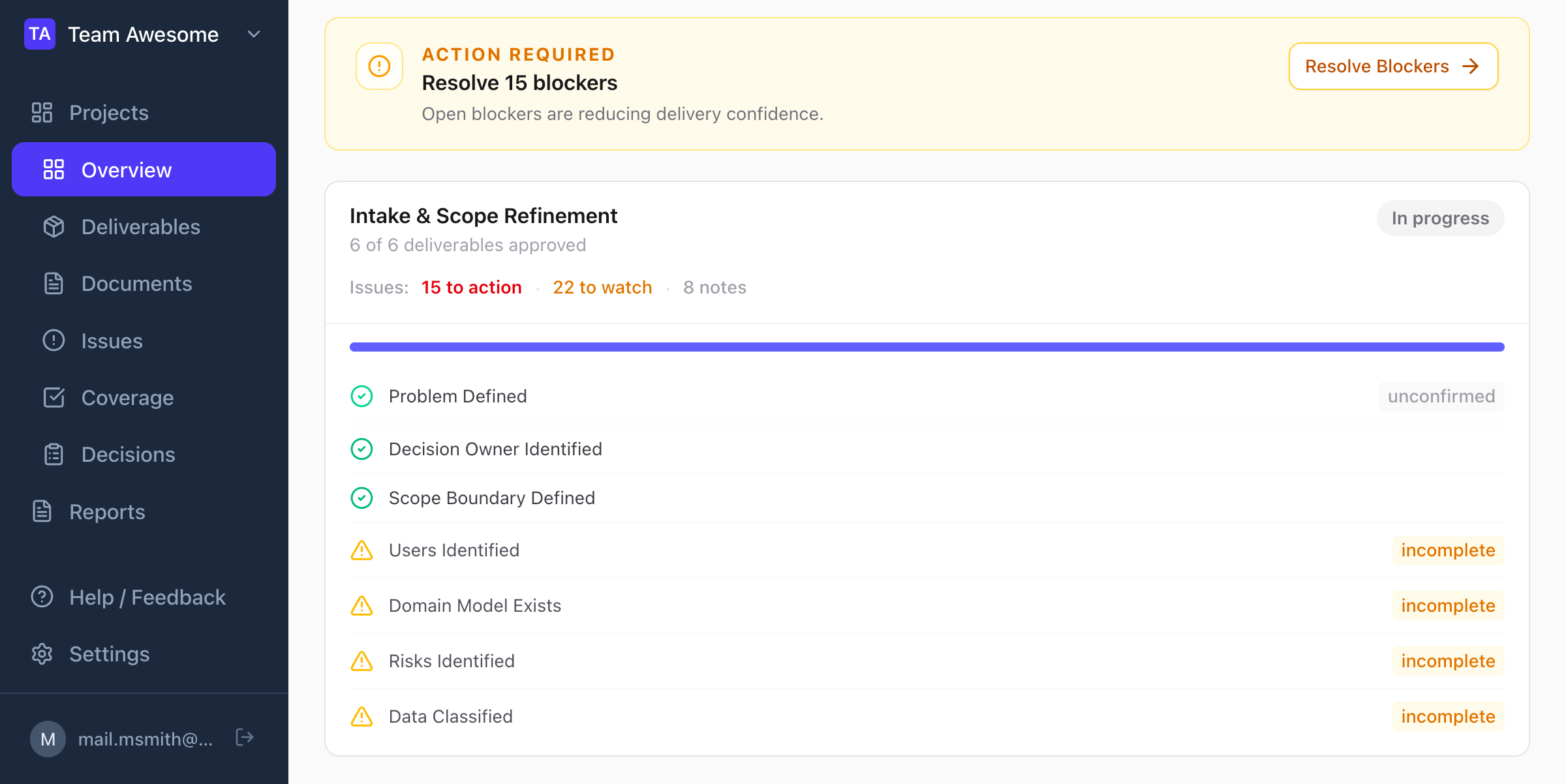
Readiness signals are derived from the project's artifacts, the truth conditions those artifacts establish, and the open issues that remain unresolved. The result is a readiness state — safe, conditional, or unsafe — for each domain of work, updated continuously as the project evolves.
This model is more honest than a gate. A project's design readiness might be conditional while its build readiness is already safe. A team can proceed in one area while tracking the specific gaps that still need resolution in another. The risk is explicit and auditable rather than hidden behind a binary pass.
Conditions, Not Opinions
Whether using hard gates or readiness signals, the underlying mechanism is the same: observable conditions rather than subjective confidence. A defined problem statement, a documented scope boundary, identified system users, a complete component inventory, user stories with acceptance criteria — these are facts about a project's state of knowledge, not opinions about whether the team feels ready.
When conditions are named explicitly, readiness becomes something the team can reason about together. The question shifts from "do we feel ready?" to "which conditions are satisfied and which aren't?" That shift is the foundation of predictable delivery.
Why This Matters
Modern software systems involve multiple teams, complex integrations, and increasing regulatory requirements. In this environment, informal transitions between phases are risky, and neither pure optimism nor pure gate-blocking serves teams well. The goal is clarity before execution — knowing what you know, knowing what you don't, and making the decision to proceed with full information rather than convenient assumptions.
The result is not slower delivery. It is more informed delivery. Instead of rediscovering requirements late in the project, teams resolve uncertainty early, when the cost of change is lowest.